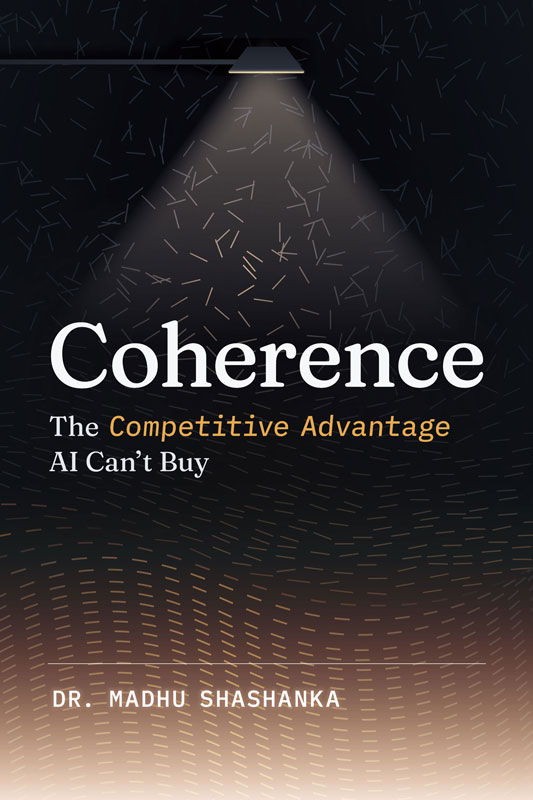
Coherence
The Competitive Advantage AI Can’t Buy
For thirty years, the fastest company won.
Agentic AI has ended that era, because when each rival can build and deploy in an afternoon, speed is no longer an advantage.
What almost nobody has noticed is that replacement: Your AI systems are all working just as designed, each one passing its own tests and improving its own metrics, while the surrounding organization becomes something nobody chose and nobody can see. Madhu Shashanka calls this complexity debt, and it compounds invisibly until it surfaces as a crisis.
Reasoning from economics, complex systems science, and twenty years spent building AI inside large enterprises, he shows that the scarce resource of this era is coherence: whether the growing crowd of autonomous systems inside a company and the people accountable for them still pull in the same direction. It is the one advantage no vendor can sell you and no competitor can copy, and Coherence is the book for the executive whose job now depends on building it.

Madhu Shashanka, PhD
Madhu Shashanka has spent more than two decades on both sides of the enterprise AI problem, building AI systems inside large organizations and selling AI products to them.
His career spans the full arc of applied AI: as a research scientist at Mars and United Technologies, where he built machine learning systems for applications ranging from retail data mining to fault detection in jet engines and helicopters; as cofounder of PetaSecure, an enterprise security startup acquired by Niara; as managing director of Data Science and Machine Learning at Charles Schwab, where he built an AI center of excellence in financial services; and as cofounder, chief scientist, and CTO of Concentric AI, where he is delivering AI-powered data security to Fortune 500 enterprises. Across industries, he has watched organizations struggle not with building AI but with governing what they build.
Madhu holds a PhD in computational neuroscience from Boston University and a degree in computer science from the Birla Institute of Technology and Science, Pilani. He is a senior member of the IEEE and served as associate editor for IEEE Transactions on Neural Networks and Learning Systems. He lives and works in Austin, Texas.
Related products
-
$30.00 Add to cart


-
$28.00 Add to cart

-
$30.00 Add to cart

-
$30.00 Add to cart


