loading...
Submit Your Book

Stephen B. Young

Historian

kissingersbetrayal.com

Stephen B. Young is the global executive director of the Caux Round Table for Moral Capitalism and the author of Moral Capitalism: Reconciling Private Interest with the Public Good, The Tradition of Human Rights in China and Vietnam, and The Theory and Practice of Associative Power: CORDS in the Villages of Vietnam 1967–1972.

He and his wife, Pham Thi Hoa, translated from Vietnamese the novel about Ho Chi Minh published as The Zenith. His 1968–1971 service in Vietnam for the US Agency for International Development in village development and counterinsurgency was highly praised by President Richard Nixon, Central Intelligence Agency Director William Colby, and ambassador to Saigon Ellsworth Bunker.

In 1975 and again in 1978, Young took a lead in successful efforts to resettle refugees from South Vietnam, Laos, and Cambodia in the United States. For many years Young was a confidant of Nguyen Ngoc Huy, the founder of the Tan Dai Viet Nationalist political party in South Vietnam.

Young also served as an assistant dean at the Harvard Law School and dean and professor of law at the Hamline University School of Law. He graduated from the International School in Bangkok, Harvard College, and Harvard Law School.

In 1966, Young discovered the Bronze Age culture of the village of Ban Chiang in Northeast Thailand, which is now a UNESCO World Heritage site. In 1989, he proposed the formation of a United Nations interim administration for Cambodia to finally put an end to the Killing Fields in that country.

ISBN:979-8-89138-468-2
Price:$32.95
Publication Date:June 2nd, 2026

America vs. the Overclass

How a New Elite Corrupted Our Nation and What We Can Do to Stop Them

In the tradition of The Lonely Crowd, an ambitious sociological, psychological, philosophical, and economic analysis of the rise since the 1960s of a new American elite whose narcissism and moral corruption threaten to destroy the fabric of the nation.

In the late 1970s, Sir John Bagot Glubb published a now mostly forgotten book called The Fate of Empires and Search for Survival, which estimated that most empires do not last more than 250 years. As America approaches that auspicious benchmark, a new elite has risen to power that threatens to make the once-great country another footnote of history.

For more than 150 years, America built itself into a global beacon of power and hope atop a firmament of covenant—a sacred commitment, exemplified in the founding documents but maintained and updated through the decades, to a societal structure based on a shared sense of history and destiny. But beginning in the 1960s with the assassination of JFK and extending into the 1970s with the identity crisis brought on by the loss of the Vietnam War all the way up to today, this covenant began to fade, and a crippling sense of dysphoria began to emerge.

In America vs. the Overclass, scholar Stephen B. Young (Kissinger’s Betrayal) reveals the deep psychosocial roots and existential danger of this turn away from the covenant and the rise of a new type of American ruling-class mentality: a powerful “other-directed,” Gnostic way of thinking that has seized the levers of power from education to business to government to turn the global beacon of power and hope into a nation of narcissistic, confused, and depressed professional managers.

Drawing together threads from Jean-Jacques Rousseau to Friedrich Hegel to Karl Marx to the great thinkers of the 20th century to today, America vs. the Overclass exposes the fateful, undercover battle going on for the soul of America—and how we can restore the covenant and save our country before it’s too late.

ISBN:978-1-63755-359-6
Price:$32.95
Publication Date:May 23, 2023

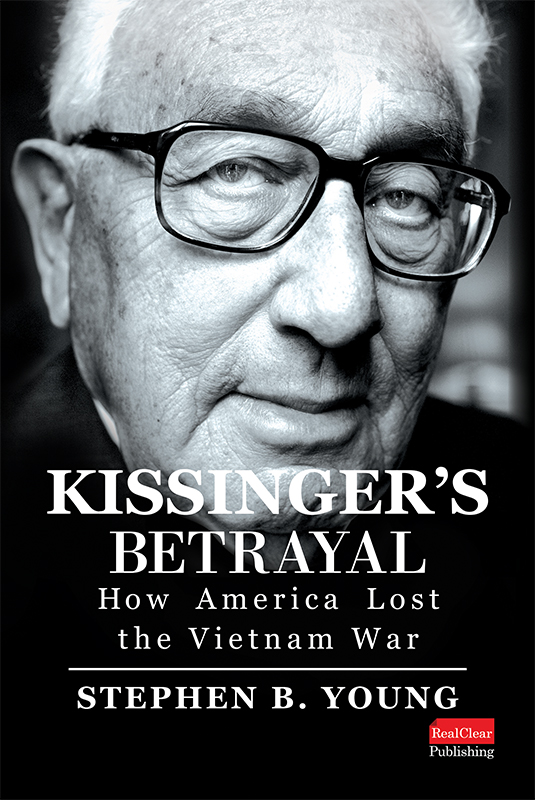
Kissinger’s Betrayal

How America Lost the Vietnam War

What really happened in Vietnam?

For five decades, conventional wisdom about the Vietnam War has been that it was lost because it never could have been won. South Vietnam was doomed to defeat. The American effort was a foreign intrusion forever incapable of winning the “hearts and minds” of the South Vietnamese people.

But what if South Vietnam was defeated not because of its own shortcomings but because it was betrayed by a secret deal made behind its back? 

Deeply researched and compellingly argued, Kissinger’s Betrayal uses once-secret files of the American ambassador to South Vietnam and long-overlooked documents from official government archives—including the foreign ministry of the Soviet Union—to reveal for the first time how Henry Kissinger personally and secretly schemed to irrevocably compromise South Vietnam’s chances for survival.

Without informing his president, other American leaders, or US allies in South Vietnam, Kissinger unilaterally made a horrendous—and ultimately completely unnecessary—diplomatic concession that allowed Communist North Vietnam to leave its army inside South Vietnam and then freely resume its war of invasion and conquest at a time of its own choosing.

In an unprecedented account, historian and global executive director of the Caux Round Table for Moral Capitalism Stephen B. Young provides new insight into both genuine Vietnamese Nationalism and the French colonialism that marginalized and decentered the right of the Vietnamese people to live freely in an independent country of their own choosing.

Kissinger’s Betrayal reveals a fresh and more truthful history of the Vietnam War that restores dignity to America as well as the people of Vietnam.

Business, Politics
Politics Only
Motivational Speaking
Sports
General Stuff
Management Ideas
Amplify Publishing Group|
620 Herndon Parkway, Suite 220|
Herndon, Virginia 20170
|
Phone: 703-437-3584|
Fax: 703-437-3554|
info@amplifypublishing.com
Shopping Cart

No products in the cart.

Sign up for APG news and industry updates